
The Practice
Five frameworks for the guilt you carry to work.
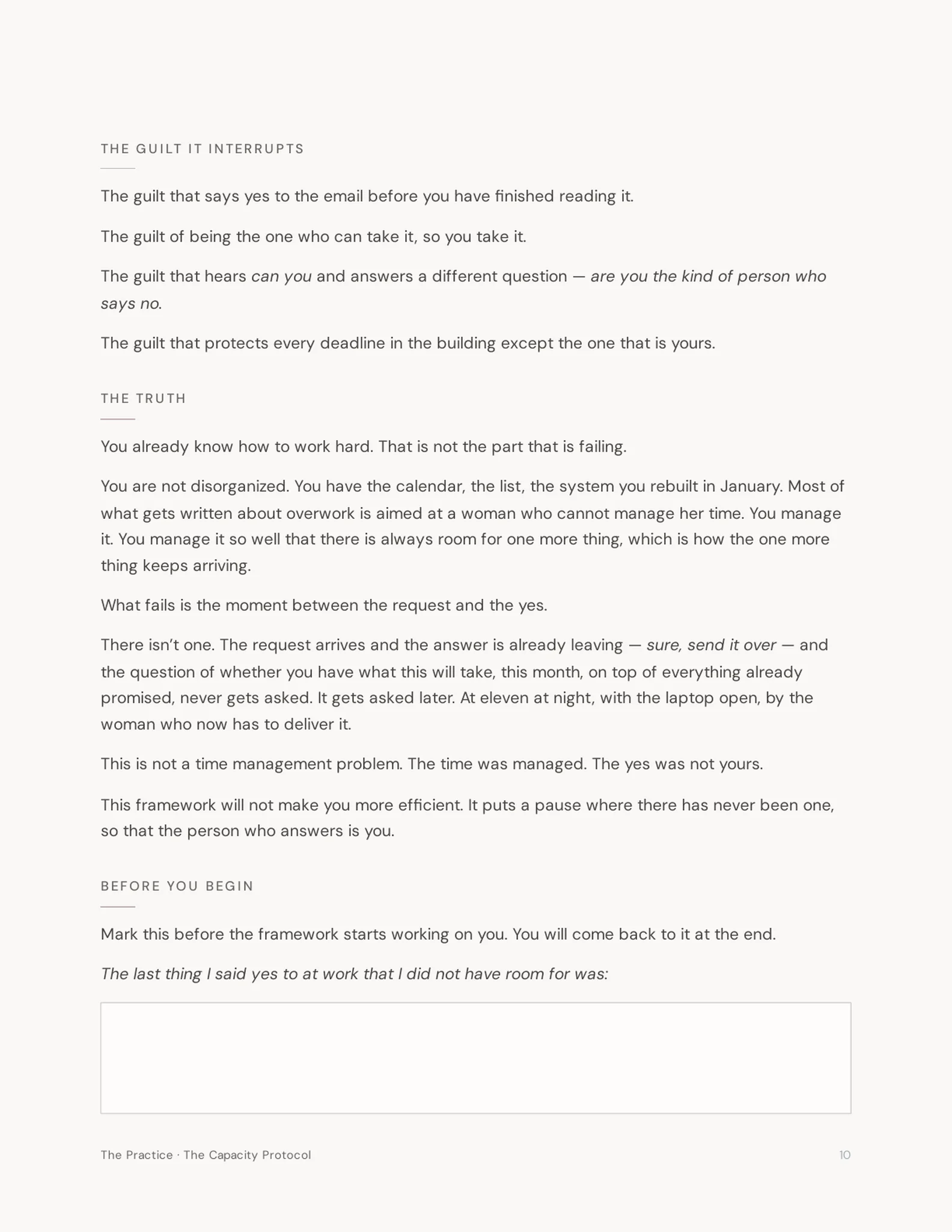
- The guilt that says yes to the email before you have finished reading it.
- The guilt that hands your work to “the team” when someone asks who led it.
- The guilt that turns I want to run it into I’d love to be involved.
- The guilt that lowers the rate between the draft and the send button.
- The guilt that sees a free Friday and fills it by noon.
You already know how to work hard. That is not the part that is failing.
What fails is the moment between the request and the yes. There isn’t one. The request arrives and the answer is already leaving — sure, send it over — and the question of whether you have what this will take, this month, on top of everything already promised, never gets asked. It gets asked later. At eleven at night, with the laptop open, by the woman who now has to deliver it.
This workbook will not make you more efficient. It puts a pause where there has never been one, so that the person who answers is you.
Five frameworks. One order.
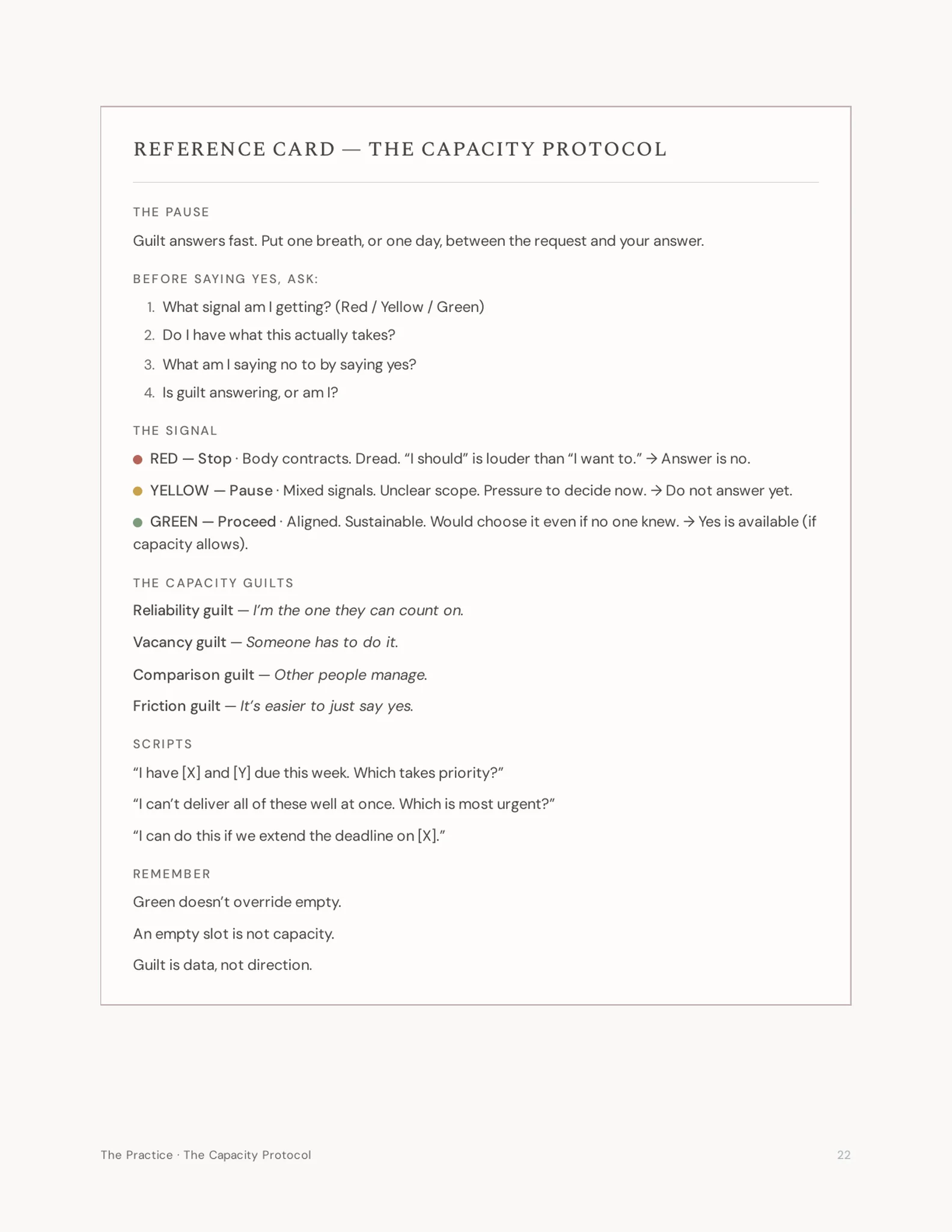
- The Capacity ProtocolA yes is a withdrawal. Most of yours were made without checking the balance.
- The Visibility ProtocolBeing seen has a price. You have been paying it everywhere, including the rooms that gave you nothing back.
- The Ambition MapYou know what you want. You have been rounding it down before it reaches your mouth.
- The Earning MapYou know what the work is worth. The number that leaves your mouth is lower, and no one asked you to lower it.
- The Opportunity FilterThe bad offers were never the problem. You have been saying yes to the good ones.
Each builds on the one before it.
Nobody had asked her to drop it. She had said yes to one thing, and the no had gone, without a sound, to the only project with no one waiting for it.
How it works
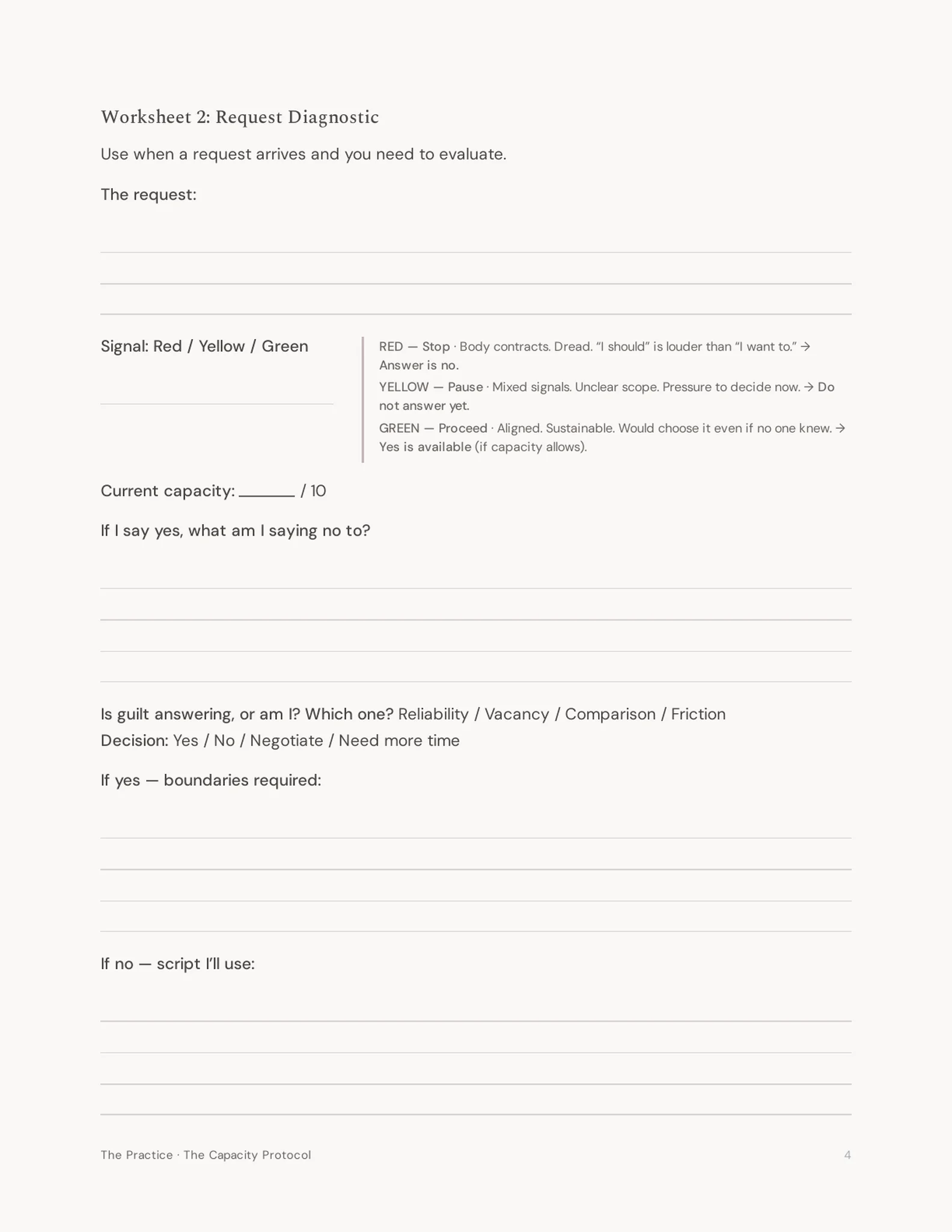
You’ll write two short lines before the framework begins, locating where you are right now. You’ll come back to them at the end. In between, you meet the mechanism: the specific guilts that answer for you at work, each with the sentence it speaks in, and the steps that interrupt them.
Then the parts The Path does not have, because work asks for them. Decision rules, for the moments when guilt has a good argument. Scripts, because at work the interruption usually has to be said out loud, to someone, in a meeting that is already moving.
Claire walks through the same work in her own job, so you can see it running in a specific week, with a specific email, at a specific desk.
This workbook will not tell you to know your worth, or to take up space, or to stop apologizing. You know your worth. What you do not yet have is a way to see what guilt has been doing in the half-second between knowing it and acting on it.
Inside the workbook
Read the first chapter
The Capacity Protocol, complete, 23 pages. It arrives when you subscribe to the weekly essay.
Questions
- Is this digital?
- Yes. A PDF you keep, yours to download the moment you buy. Print the worksheets as often as you come back to them.
- Do I need The Path first?
- No. If this is your first Soft Era workbook, everything you need is in these pages. The Path is the same architecture, built for your personal life — your energy, your boundaries, your rest, your care, your decisions.
- My work doesn’t look like Claire’s.
- Claire manages a team at a firm. Her work will not look like yours. Your industry is different, your seniority is different, you may not have a manager at all. Her guilt will look exactly like yours. The framework is what travels between her job and yours.
- Will this work where I work?
- These frameworks assume a reasonably functional professional environment — one where competence is recognized, boundaries are possible, and advocating for yourself does not automatically result in punishment. Not all environments meet that standard. If yours doesn’t, the question may not be how to work differently. It may be whether this is the right environment for you. That is also data.
- Is this therapy?
- No. It’s self-directed, and it is not a substitute for mental health care. Some of what surfaces will be uncomfortable. If it feels like more than you can hold alone, pause and find support. That is the same discernment the workbook is built to teach.